


Every year brings another round of “Africa’s AI moment” headlines — new accelerators, founders jetting off to San Francisco and returning with pitch decks that read like a YC template, roadmaps that mirror whatever just raised a huge round in the US.
A few months later, most of it quietly fizzles out.
It isn’t a talent problem or a funding problem. It’s that too many builders are still working from someone else’s blueprint.
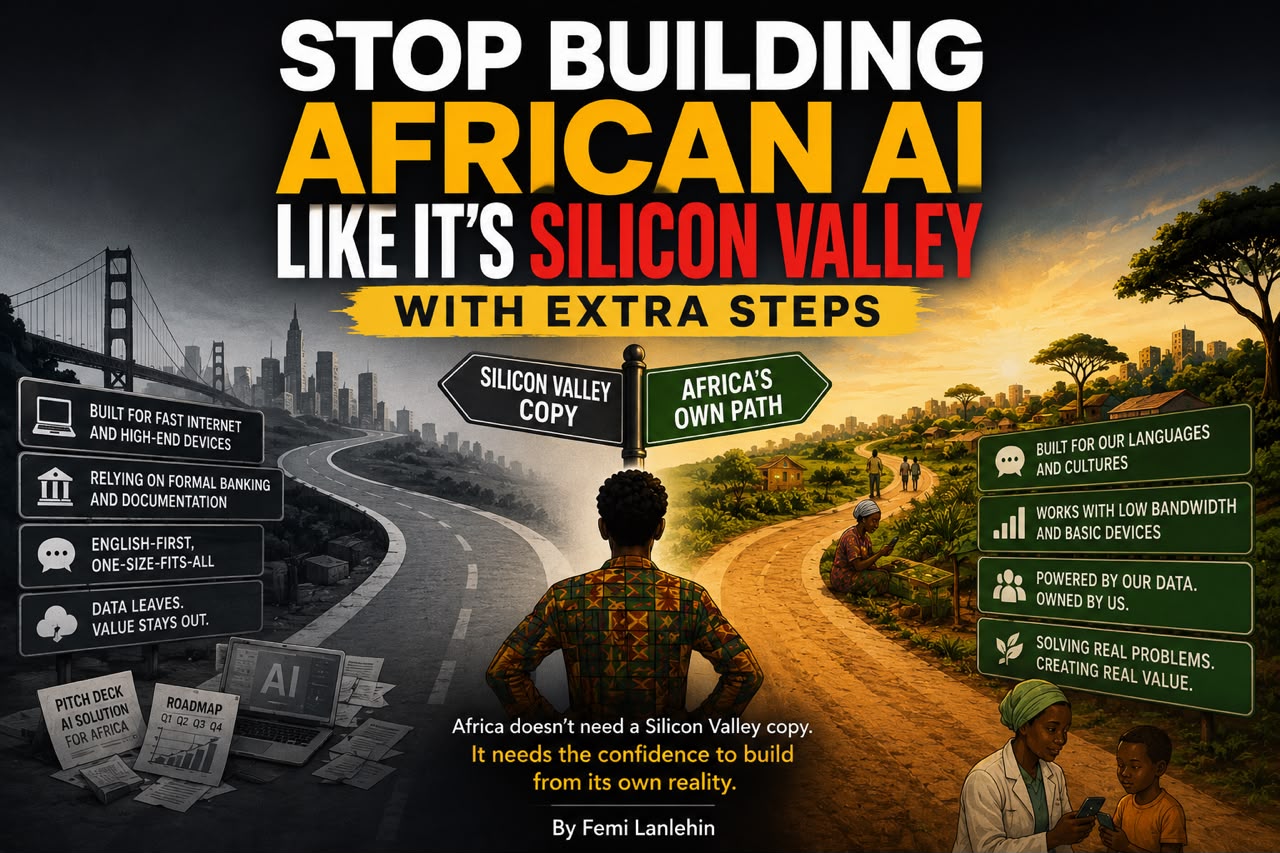
Silicon Valley’s model was built for reliable broadband, formal banking records, English-first markets, and users who already trust institutions with their data. Almost none of that describes most of Africa.
Until builders design around African reality instead of retrofitting American products, “transformation” stays a buzzword on a slide.
African Problems Need African-Built Answers
Africa’s constraints aren’t bugs to route around — they’re the actual spec. With well over 2,000 languages, most barely represented in NLP datasets, a model trained mainly on English can’t genuinely serve this continent.
Where the nearest doctor might be hours away, a health tool needs to work over basic SMS, not assume a smartphone and a data plan. Where most economic activity is informal and undocumented, credit models built on Western banking data are simply useless.
These aren’t rare edge cases — they’re the majority reality. A system that can’t handle multiple languages, patchy connectivity, and an informal economy isn’t just imperfect for Africa; it’s often unusable.
That shifts the priorities too: instead of productivity apps and enterprise SaaS, the biggest wins look like crop-yield forecasting for smallholder farmers, multilingual health triage, banking the unbanked, and public services delivered at a scale no single startup can reach alone.
What Goes Wrong When You Import Instead of Adapt
Copying existing tech is cheaper and faster than building from zero — that’s the appeal. But skipping real localization tends to break in three predictable ways.
Language and culture get lost. Assistants trained on Western text often can’t handle pidgin, code-switching, or local dialects, and end up giving flattened, generic answers that miss the point entirely.
Infrastructure assumptions fail. Anything built expecting constant connectivity and modern devices stops working where power and data are unreliable. That’s not an inconvenience — it’s a lockout.
Data flows out without ownership flowing back. When African user data trains foreign models, and African markets consume products priced and built elsewhere, the continent becomes a testing ground rather than a beneficiary. Some call this data colonialism.
The risk is real: value gets captured elsewhere while Africa carries the operational costs.
Building It Right
None of this means shutting out global research or partnerships. It means flipping the process — starting from African constraints and building outward, instead of starting with a Silicon Valley product and bolting on localization afterward.
In practice, that looks like:
• Real, sustained investment in African-language datasets and models — ongoing work led by African linguists, not a one-off hackathon.
• Offline-first design — SMS/USSD compatibility and low-bandwidth interfaces as the default, not an add-on for “emerging markets.”
• Public-private partnerships that use government-controlled channels — health systems, ID systems, agriculture networks — to reach a scale no startup can hit alone.
• African universities doing foundational AI research, not just consuming models built elsewhere.
• Data and IP generated by African users staying under African control wherever possible.
None of this happens fast. It needs patient capital and partners willing to move at government speed, not startup speed. But the payoff is an AI ecosystem that actually works for the people it’s meant to serve — one that creates value on the continent instead of just extracting it.
Africa doesn’t need a Silicon Valley copy. It needs the confidence to build from its own reality.